Your reviews went up by seven. Nobody can tell you what that did
Every tool you run is descriptive. It tells you what happened and stops. We measure what your activity actually moves — then send you the thing to do about it.





The problem.
You have every number about your business and no way to know what moves which
It's all descriptive
Reviews up seven this week. Fourteen more ads launched. Every tool reports its own surface and none of them are measured against anything.
Nothing to measure against
You collect plenty of independent variables. There's no dependent variable — nothing that tells you the fourteen ads are what moved your ranking from four to three.
How it works.
Read everything you already run, then tell you what to do about it
Three stages. Get the data, find what actually moves what, hand back the one thing worth doing.
Get the data
Reviews, ads, search, content, bookings. We read the systems you already run, continuously, without asking you to plug anything in.
Find what moves what
This is the part everyone skips. We put a dependent variable on it, so we can say one more five-star review is worth ten Instagram followers — and show the work.
Send you the move
Not a chart. The thing to do, why it's first, and what we expect it to move. This is specialized ML trained on your vertical's own operating history — not a general-purpose LLM guessing at your business.
The deliverable.
You can see where it came from
Every move opens onto the data behind it — which systems it pulled from, what we tested, and the tests that came back with nothing. We keep those too.
One thing goes first
Not a list of everything wrong with your business. One move goes first, and it tells you why it beat the others.
Nothing runs without you
It still needs the human eye. Every move has a name on it and waits for you to approve it — we don't touch your accounts on our own.
It's just a dashboard. There's no action to it.
So we built the part that comes after the chart
One thing at a time
Ordered by what actually moves your numbers, not by whichever tool sent the loudest notification.
Open it and check
Every number opens onto where it came from and what we tested. Including the tests that found nothing.
You approve it
Nothing executes on its own. You decide, and we keep the record of who decided what.
In the data.
Things we already found in real operating history
Demand / supply
21.3 → 1.2%
People are searching for something nobody posts about
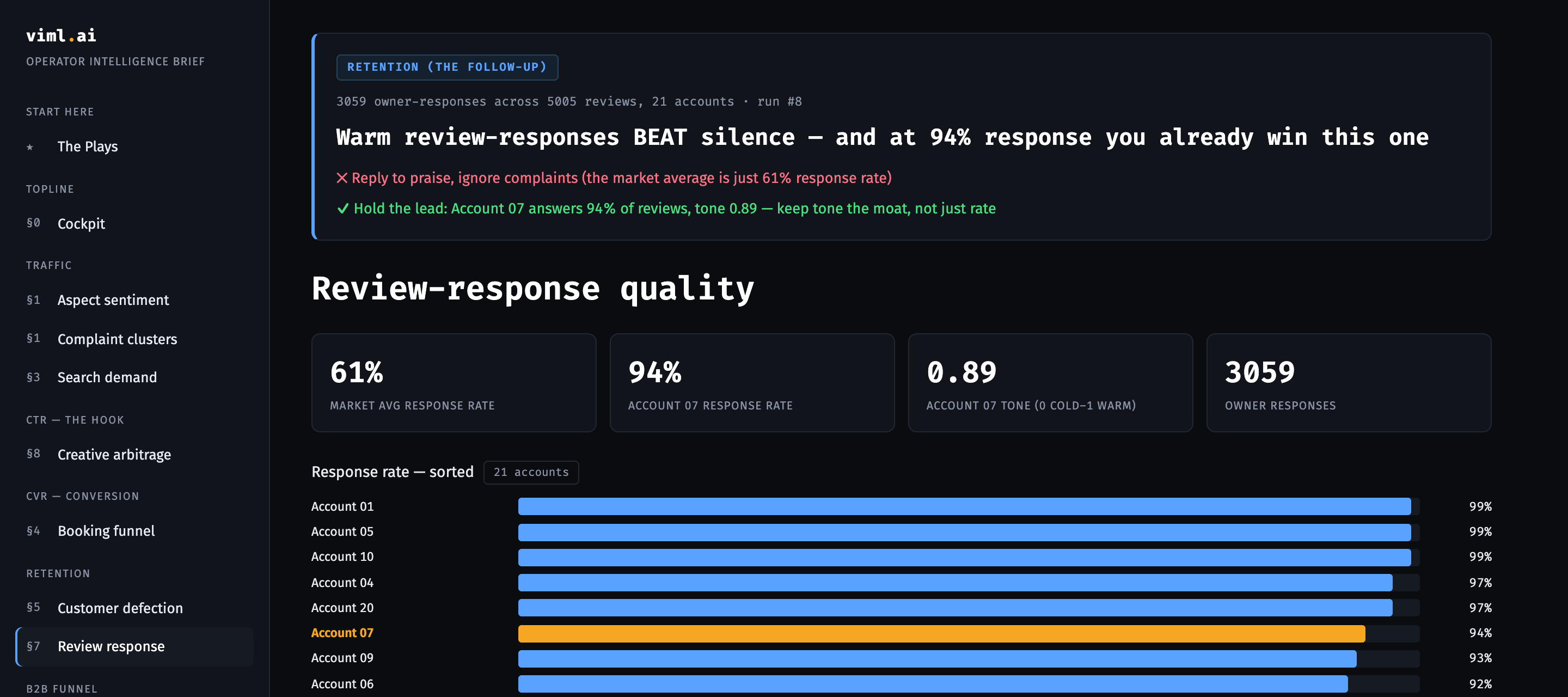
Review response
0.885 AUC
You can predict which reviews get a reply
Creative congruence
1.30× views
Say what the video actually shows and it goes further
Channel alignment
V = 0.438
The ads and the page are telling two different stories
Creative lifetime
0 vs 41 days
The pushiest ad dies the fastest
Format fit
2.11× views
Short only wins if there is nothing to explain
1/3
How we build.
If it wasn't measured, it doesn't exist. Every move comes with the data behind it and the tests it went through, including the ones that found nothing.
Measured, not asserted
How we handle data